
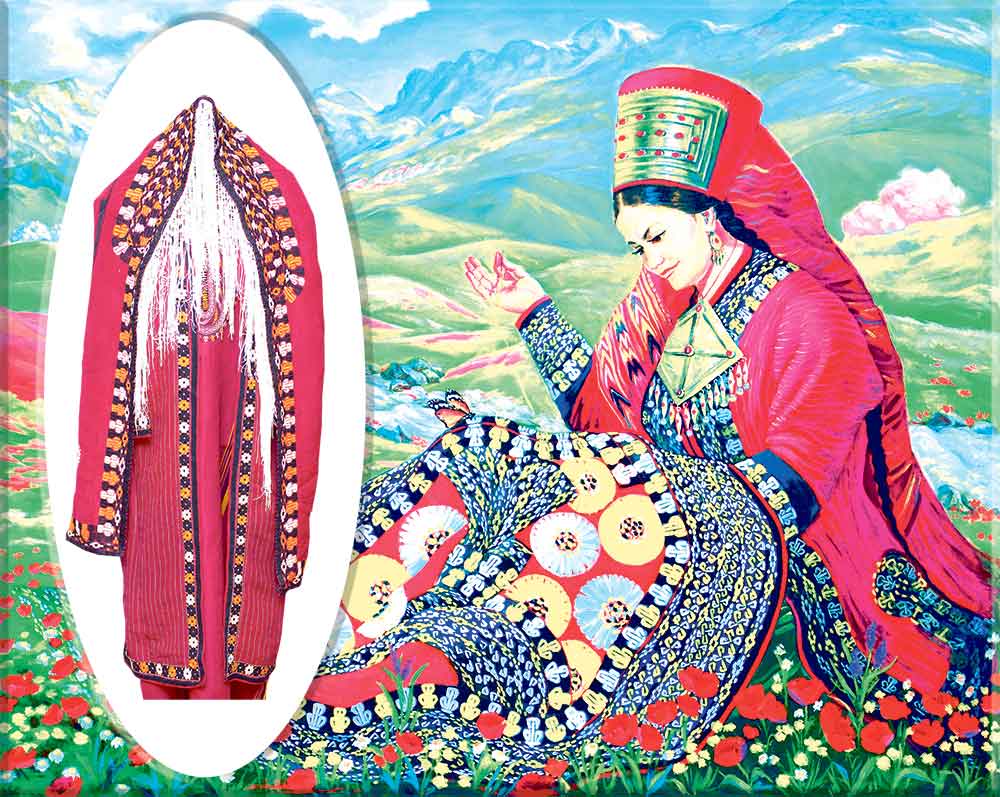
Women's scarves – a world of beauty
We are living in a new era of our sovereign state. Historical and literary sources testify that the national costumes and ceremonial attire of the Turkmen people have their roots deep in the centuries. In the past, our ancestors wore clothes to protect themselves from the cold, heat, wind, and rain, but over time, as these clothes were passed down from generation to generation, they were improved and, in addition to providing protection, also acquired decorative significance. Our ancient brides and grooms hand-wove, embroidered, and sewed all kinds of national costumes. In ancient times, it was considered shameful for a girl or bride to walk around the house with her head uncovered. From the age of 8-9, girls were dressed in a turban, and from the wedding period until the last years of their lives, they wore various types of embroidered headdresses. Among the artistic embroidery that we have inherited from our grandmothers, women's headdresses—kurtas and turbans—are the most artistically perfect and beautiful items. Kurtas, the pride of the Turkmen people, amaze everyone with their unique beauty. The permanent exhibition of the State Museum of the State Cultural Center and the museum's material and cultural fund contain a large collection of various women's headdresses related to national clothing. Despite the long years, we see that the colors of the patterns on the kurtas and turbans still shine like new. Looking at them, one cannot help but admire the elegance of these wonderful embroideries. The exquisite patterns on these headdresses clearly show that our grandmothers taught their daughters to embroider from childhood, and by the time they grew up, they had become masters of their craft. Although the shawls that women wore during holidays and celebrations were similar in style and tailoring, they differed in color, pattern, and dress code. Green and yellow shawls were made of handmade silk fabric without a border with fringe. While kurtas had real sleeves, like donas, long, thin, single-layer "false" sleeves were sewn onto the shawls. A thin, long collar was attached to the sleeves. A narrow or wide woven strip with red and black stripes was sewn to the cuffs. Later shawls became more elegant: the ends of the collars were trimmed with yellow and white.